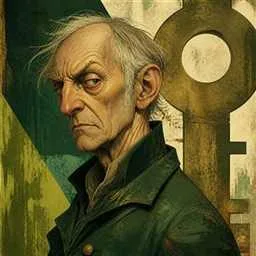
Argus Filch is Hogwarts’ caretaker, frequently encountered when pupils risk being caught somewhere they should not be. Paul Whitehouse is officially announced in the role for the HBO series.
Filch in the first book
The official encyclopedia identifies Filch as the school caretaker and Mrs Norris as his cat and effective helper in detecting trouble. It also identifies his lack of magical ability as wider-series context; readers meeting him in book one need not have every later revelation explained immediately.
Our interpretation: Filch makes rules feel like a physical presence in the corridors. A notice about curfew is abstract until a pupil hears footsteps or sees a watchful cat. He also reminds readers that a magnificent castle contains maintenance, cleaning and resentment as well as wonder. The viewpoint of a child on an adventure and that of someone left with the mess will not be identical.
Book context: Philosopher’s Stone, chapters 7, 9, 12, 15.
Book-one moments after hours
Book-one spoilers: Filch is part of the risk surrounding the proposed midnight duel and the children’s movements through the castle. Mrs Norris intensifies the sense that being unseen by an adult may not be enough. The night-time sequences make attention, sound and timing part of school geography.
Our reading: the caretaker does not need to understand the central mystery to obstruct a child trying to solve it. That is a useful distinction in a school adventure. Ordinary authority can create immediate danger for the protagonist without being the story’s hidden villain. Follow what Filch actually knows in a scene, rather than granting him the information available to Harry or to a reader who has already reached the ending.
Book context: Philosopher’s Stone, chapters 7, 9, 12, 15.
Filch in the 2001 film
David Bradley plays Filch in the first film. Compare how his presence is announced with how the novel builds suspense around being caught. A film can use footsteps, a light source, a doorway or Mrs Norris before the human figure occupies the centre of the shot.
Our view: his relationship with space matters as much as a particular scolding line. The corridors belong to pupils during much of the day, but after hours an adult’s appearance changes their meaning. Familiar routes can become threatening without a new magical creature. This is a productive comparison for viewers interested in atmosphere: the same building can offer comfort, secrecy or exposure depending on who else is awake.
Order against disorder
Filch’s hostility towards Peeves gives Hogwarts an ongoing dispute that exists beyond Harry’s plot. The official fact file names the conflict. Our interpretation is that it also gives mischief a consequence: one inhabitant enjoys creating trouble and another has to confront the results.
The twins offer a third perspective, treating rule-breaking as an opportunity for humour. Comparing those characters can make school life richer without treating every joke as admirable or every rule as sensible. Ask who is inconvenienced, who controls the situation and whose reaction supplies the comedy. Those questions allow a guide to describe the humour while still noticing the imbalance between adults, older pupils and frightened first years.
Book context: Philosopher’s Stone, chapters 7, 9, 12, 15.
Discussion: the cost of being noticed
Our reading: Filch changes a scene because discovery can be consequential even when a pupil has a good private reason for being out. Ask which explanation an adult could reasonably know at that moment. The gap between a child’s purpose and the visible rule-breaking creates suspense without requiring another magical attack. That ordinary kind of danger helps the school setting support the adventure.
Ask when a familiar route becomes frightening simply because another inhabitant might notice the child using it.
Book context: Philosopher’s Stone, chapters 7, 9, 12, 15.
What to watch for in the series
Questions for viewing and discussion:
- How will Mrs Norris’s presence change the feeling of a corridor before Filch appears?
- What will distinguish an ordinary rule-breaking scene from a moment of genuine threat?
- How will the series establish his dispute with Peeves as part of everyday school life?
- How will cleaning and maintenance make the castle feel inhabited beyond its spectacle?
The announced actor
- Official: Paul Whitehouse — Argus Filch.
Read and listen
Read the midnight-duel material and the Christmas wandering sequence for two different forms of suspense after hours. In audio, listen for descriptions that make Harry stop, hide or reinterpret a sound. Compare those moments with the film’s use of space and light. An unabridged first novel gives Filch a school context beyond a collection of reprimands. Our Peeves guide follows the caretaker’s most persistent source of disorder, while the twins guide considers mischief from the pupils’ side. Keep later revelations about Filch separate if sharing this reading path with a newcomer.
Compare print editions · Choose an audiobook · More character guides
Sources
- Official: Announced performers and roles; Ginny cast distinguished by season.
- Primary novel reference: Harry Potter and the Philosopher’s Stone, chapters 7, 9, 12, 15. Plot context, not a new production claim.
- Official: Explore the linked character reference for background; this guide keeps later-book revelations out of view.
- Primary film reference: Released 2001 film is primary comparison; no production-motive claim.