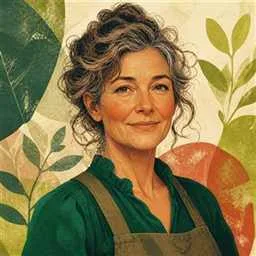
Pomona Sprout teaches Herbology and heads Hufflepuff at Hogwarts. Sirine Saba is officially announced to play her in the HBO series.
Sprout in Harry’s first year
The official encyclopedia places Sprout in the school greenhouses and identifies her as Head of Hufflepuff. Her subject concerns magical plants, including useful and dangerous species. That combination matters to the first novel’s account of learning: a living thing can require knowledge and care while also presenting a risk.
Our interpretation: Herbology gives Hogwarts a physical texture different from a classroom full of desks. Soil, growth, handling and observation imply work that cannot be reduced to saying an incantation. A guide to the first year benefits from noticing that variety, even though the central mystery does not give every lesson an equal amount of space.
Book context: Philosopher’s Stone, chapters 8, 16.
Book-one learning beneath the trapdoor
Book-one spoilers: Devil’s Snare is one of the obstacles beneath the trapdoor. The children need to recognise a plant and respond to its properties. The official Chapter Sixteen reading activity lists defeating Devil’s Snare among the challenges.
Our reading: a classroom subject acquires dramatic importance when a pupil recognises something encountered through study. Compare recognition with execution: knowing what a thing is and doing the right thing while frightened are not identical tasks. The first book’s trio works because knowledge, composure and action move between friends. Sprout’s subject is therefore relevant even where the teacher herself is not standing beside the pupils to explain the next step.
Book context: Philosopher’s Stone, chapters 8, 16.
Sprout and the film comparison
Miriam Margolyes’s screen portrayal of Sprout is associated with Chamber of Secrets, the 2002 film, including the memorable Herbology lesson with Mandrakes. Keep that second-year material distinct from the 2001 film’s handling of Devil’s Snare. A familiar later scene should not be presented as an event in the first film.
Our view: this distinction creates a useful question for the television version. More classroom time could establish a subject through its teacher before the story needs a remembered fact in a crisis. The casting confirms Sprout’s presence, while the actual lesson content remains a question for viewing. Comparing the first novel with the later film can still be useful if the book, year and medium are named clearly.
Care, expertise and another house
Sprout also offers a route beyond Gryffindor-centred school life. The official encyclopedia connects her teaching with care for pupils, including Neville’s interest in plants across the wider story. That later development should remain outside a first-book plot summary unless a reader opens a separately labelled spoiler section.
Our interpretation: the useful first-year question is what a specialist teacher notices in pupils who struggle elsewhere. Different subjects can reveal different strengths. An adaptation need not make every lesson a clue to the final mystery for those lessons to matter; some establish the habits, relationships and discoveries that make school life convincing.
Book context: Philosopher’s Stone, chapters 8, 16.
Discussion: knowledge of living things
Our view: Herbology is an opportunity to notice how a magical school treats knowledge that comes through observation and handling. A plant has conditions in which it thrives or becomes dangerous. Understanding it requires attention to those conditions, not only confidence with a wand.
For a comparison, ask how the setting communicates work. A greenhouse can suggest growth, clutter and routine care before anyone explains a lesson. A dangerous plant then belongs to an environment of expertise rather than appearing only as an obstacle. This is a useful way to discuss adaptation design while leaving the actual television classroom details open until they are shown.
Compare recognising a plant with knowing how to handle it safely; the two require related but distinct understanding.
Book context: Philosopher’s Stone, chapters 8, 16.
What to watch for in the series
Questions for viewing and discussion:
- How will the greenhouses differ in sound, light and pace from the indoor classrooms?
- Will Sprout’s teaching establish plant knowledge before it becomes urgent beneath the trapdoor?
- What will distinguish her approach to nervous or inexperienced pupils?
- How will Hufflepuff life become visible around a story chiefly following Gryffindors?
The announced actor
- Official: Sirine Saba — Pomona Sprout.
Read and listen
Read the early description of Hogwarts subjects alongside the Devil’s Snare passage. The connection is useful for thinking about how ordinary learning becomes action. An unabridged audiobook lets you hear the shift from classroom pace to panic, while the printed page makes it easy to compare each child’s contribution. If continuing to Chamber of Secrets, keep notes for that book separately so Mandrakes do not drift into your first-year summary. Our Neville and Hogwarts guides provide related reading about different kinds of ability and the school’s range of subjects.
Compare print editions · Choose an audiobook · More character guides
Sources
- Official: Announced performers and roles; Ginny cast distinguished by season.
- Primary novel reference: Harry Potter and the Philosopher’s Stone, chapters 8, 16. Plot context, not a new production claim.
- Official: Explore the linked character reference for background; this guide keeps later-book revelations out of view.
- Official: Book-one obstacles and/or Neville common-room confrontation.
- Primary film reference: Released 2001 film is primary comparison; no production-motive claim.