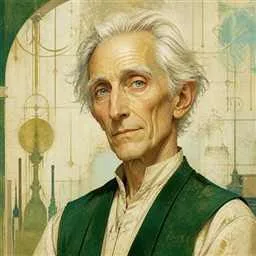
Garrick Ollivander is the Diagon Alley wandmaker who helps Harry find his first wand. Anton Lesser is officially announced to play him in the HBO series.
Ollivander in book one
The official encyclopedia identifies Ollivanders as his family wandmaking business and Harry’s wand as holly with a phoenix-feather core. In Philosopher’s Stone, the shop is one of Harry’s first encounters with a specialist who understands something about him that he cannot yet explain himself.
Our interpretation: the scene turns shopping into recognition. Harry needs an item for school, but the process also suggests that entering the magical world involves more than purchasing interchangeable equipment. A wand’s suitability has to be discovered. The effect is strongest when Harry remains uncertain while the expert observes, remembers and tests. Knowledge has an atmosphere here as well as a practical use.
Book context: Philosopher’s Stone, chapters 5.
The first wand and its unsettling connection
Book-one spoilers: Harry tries wands before finding the one that suits him. Ollivander explains a connection between its phoenix-feather core and the wand associated with Voldemort’s attack. The detail places an unsettling question inside what might otherwise feel like a successful school-shopping errand.
Our reading: discovery becomes double-edged. Harry has found something that belongs with him, yet the explanation ties him to a past he is only beginning to understand. The scene does not require a first-time reader to know how that connection will develop in later novels. Its immediate power lies in the collision between welcome and unease. A useful reread asks when the mood changes and what, exactly, Harry has learned by the time he leaves.
Book context: Philosopher’s Stone, chapters 5.
Ollivander in the 2001 film
John Hurt plays Ollivander in the first film. The shop sequence is a compact study in how performance can make expertise compelling. Compare the attention given to Harry’s reaction with the wandmaker’s measured certainty, and the physical testing with the explanation that follows.
Our view: silence and anticipation do a large part of the work. An ordinary transaction becomes strange because an adult appears to recognise a pattern beyond the child’s knowledge. Look at how the shop’s narrow space and stored objects shape the encounter. They can suggest an accumulated professional history without a biography being spoken aloud. The audience needs enough explanation to understand the immediate significance while retaining curiosity about what lies beyond it.
Expertise without a catalogue of later lore
Ollivander’s first appearance can tempt a guide into explaining every later rule about wands. For a first-year reading, preserve the scale of Harry’s knowledge. Our interpretation is that selective information makes the scene work: the wandmaker knows more than he says, and Harry cannot yet place all he hears.
The interesting adaptation questions concern how that imbalance becomes visible. An expert can be kind, intimidating or simply absorbed in his work; the child’s reaction may combine all three experiences. Compare Ollivander’s kind of authority with Hagrid’s practical welcome. Hagrid brings Harry to the right place, but a different person supplies the specialist knowledge. The magical community becomes convincing through those overlapping forms of competence.
Book context: Philosopher’s Stone, chapters 5.
Discussion: a shopkeeper who remembers
Our interpretation: remembering is a form of authority in the wand shop. Harry has only just begun asking about his past, while an adult can connect objects, customers and events across time. Consider how that imbalance changes an ordinary purchase. A useful adaptation comparison asks how recognition becomes visible before the explanation is complete, and how Harry’s uncertainty survives the satisfaction of finding a wand.
Consider what Harry knows when he enters, then name the different kinds of knowledge he carries out.
Book context: Philosopher’s Stone, chapters 5.
What to watch for in the series
Questions for viewing and discussion:
- How will the wand-testing sequence build anticipation before the successful match?
- What will distinguish Ollivander’s specialist manner from the other adults Harry meets in Diagon Alley?
- How will the connection with Voldemort alter the mood of a shopping scene?
- How much explanation will let new viewers follow the encounter while preserving its mystery?
The announced actor
- Official: Anton Lesser — Garrick Ollivander.
Read and listen
Read the whole Diagon Alley chapter so the wand shop sits among different experiences of money, supplies and belonging. In audio, compare the atmosphere of the shop with the busier public spaces around it. The printed passage is useful for following exactly what Harry is told about the wand connection, without importing later explanations. Choose an unabridged first novel for that comparison. Our Harry and Griphook guides follow the other side of this first magical shopping trip: a child discovering resources, institutions and knowledge that existed before he knew he belonged to the world around them.
Compare print editions · Choose an audiobook · More character guides
Sources
- Official: Announced performers and roles; Ginny cast distinguished by season.
- Primary novel reference: Harry Potter and the Philosopher’s Stone, chapters 5. Plot context, not a new production claim.
- Official: Explore the linked character reference for background; this guide keeps later-book revelations out of view.
- Primary film reference: Released 2001 film is primary comparison; no production-motive claim.