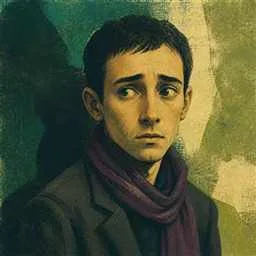
Quirinus Quirrell teaches Defence Against the Dark Arts during Harry’s first year. His place in Philosopher’s Stone is inseparable from the mystery, so the detailed sections below contain the first book’s ending.
Who Quirrell is in book one
The official character encyclopedia identifies Quirrell as Harry’s first Defence Against the Dark Arts teacher. That job places him within the school’s teaching staff, while his nervous outward manner affects how the children perceive him. The most useful starting point is what a first-time reader sees before knowing the solution.
Our interpretation: apparent weakness can shape attention as strongly as overt menace. If a reader instinctively looks elsewhere for danger, a teacher’s manner has already done narrative work. Consider how information is distributed rather than searching only for a secret clue. Who is in a room, whose reaction is described and which explanation feels easiest to accept? Those questions make Quirrell’s role a study in perspective rather than merely a last-chapter surprise.
Book context: Philosopher’s Stone, chapters 5, 7–8, 10–11, 16–17.
Book-one spoilers: Key book-one moments
Book-one spoilers: Harry encounters Quirrell before the final confrontation, and the teacher is present within familiar school routines. During the Quidditch match, attention is directed towards Snape. The ending establishes Quirrell’s involvement in the danger and Voldemort’s presence, requiring the reader to reconsider earlier events.
The confrontation beside the Mirror of Erised brings the school mystery into the same room as Harry’s family history. It also explains why wanting the Stone matters to the magical protection around it. For a careful reread, return to the first encounters and the Quidditch chapter after finishing. Keep separate what the narration directly supplies and what the children assume. The ending changes an explanation; it does not mean the earlier observations were all meaningless.
Book context: Philosopher’s Stone, chapters 5, 7–8, 10–11, 16–17.
Quirrell in the 2001 film
Ian Hart plays Quirrell in Philosopher’s Stone. The released film can be compared with the novel through staging, sightlines and the handling of suspicious behaviour. A camera can reveal someone while encouraging the viewer to attend to somebody else, just as prose can place a detail inside Harry’s interpretation.
Our view: the final scene works as a performance challenge because the audience must see continuity and change at once. The same character now carries a different meaning. Compare voice, stance and pace with the earlier classroom presence. Avoid assuming that every early gesture must function as an obvious warning; part of the effect lies in discovering how an apparently familiar person has been understood through incomplete information.
Primary comparison: released film.
Teaching, threat and reader attention
Quirrell’s subject gives the first year a particular irony: a school offers lessons about danger while danger can be hidden within its own adult world. Our reading is that this makes the children’s need for judgement more complicated than simply learning which corridor is forbidden.
A good adaptation discussion can ask how much access viewers have to a teacher when Harry is absent. Additional staff-room material might alter the balance of suspicion even without revealing a secret. Compare the experience of following Harry closely with the experience of a wider ensemble story. Each approach gives the audience different opportunities to suspect, misunderstand and retrospectively connect what they have seen.
Book context: Philosopher’s Stone, chapters 5, 7–8, 10–11, 16–17.
Discussion: the information available at the time
Our interpretation: a second reading should not make a first-time reader feel foolish for being surprised. A mystery arranges information and attention deliberately. Make a list of what Harry could know at the end of each relevant chapter, leaving out the solution. The resulting uncertainty is part of the design, not a failure to notice something obvious.
Then distinguish an event being hidden from an event being misinterpreted. Those mechanisms produce different kinds of reveal. If something happened in view but acquired the wrong explanation, returning to it can be especially rewarding. Quirrell’s place among the staff makes this question relevant to how familiar settings invite trust.
In a film discussion, choose a shot containing more than one possible focus. What do movement, speech and a character’s gaze encourage you to watch? An audience can see a person without attending to them. Compare that effect with a paragraph in which Harry is thinking about someone else. This is a concrete way to discuss misdirection without inventing secret signals or treating every feature of a performance as evidence of the ending. The most useful question remains what the scene allows a newcomer to understand at that moment.
For a shared reread, let each person name the earliest detail they now interpret differently. Require a chapter reference and distinguish the detail itself from the new explanation attached to it.
Book context: Philosopher’s Stone, chapters 5, 7–8, 10–11, 16–17.
What to watch for in the series
Questions for viewing and discussion:
- How closely will the series tie Quirrell’s presentation to Harry’s point of view?
- Will everyday Defence lessons make his teaching style distinct before the mystery reaches its conclusion?
- What will the Quidditch sequence ask viewers to notice or overlook?
- How will the final confrontation connect the school mystery with Harry’s earlier experiences?
- How can the ending reward a second viewing without making the first viewing depend on an obvious signal?
Read and listen
Quirrell is best approached with two reading passes. First experience the mystery in order; then compare the early encounters, the Quidditch match and the final chapter with the solution in mind. For audio, consider how a performance directs suspicion through contrast between voices, while remembering that Harry’s interpretation also shapes what is being heard. Choose the unabridged first novel for that exercise. The Mirror material is worth reading alongside our Harry and Dumbledore guides, because the same object carries emotional meaning, a warning about desire and a final protective function.
Compare print editions · Choose an audiobook · More character guides