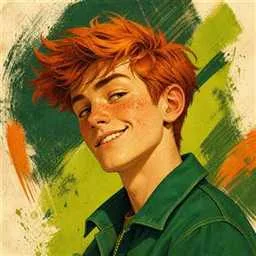
Fred and George Weasley are Ron’s older twin brothers and Gryffindor pupils when Harry starts Hogwarts. Their jokes and practical help offer Harry a lively introduction to school and to the Weasley family.
Who Fred and George are in book one
The twins are part of the Weasley household Harry encounters on the way to Hogwarts. The official character entries identify their shared delight in jokes and their close partnership. In the first novel they are older pupils with enough school experience to move through the journey and castle more comfortably than Harry or Ron.
Our interpretation: familiarity can be a form of welcome. A complicated boarding-school departure looks less forbidding when older children already know how to manage trunks, platforms and family teasing. At the same time, a joke can be reassuring to one person and unsettling to another. The twins are useful characters for noticing that distinction, especially when their ease is set beside Ron’s self-consciousness or Percy’s concern with responsibility.
Book context: Philosopher’s Stone, chapters 6–7, 9, 11–12, 17.
Book-one spoilers: Key book-one moments
Book-one spoilers: the twins help Harry with his trunk before the train journey. Their reaction to his identity adds another version of what it means to meet the famous new boy. At Hogwarts they are part of Gryffindor’s Quidditch team and the house’s social world, connecting Harry with older pupils outside lessons.
At Christmas, the Weasley family’s gifts and humour bring a feeling of home into the castle. Read those scenes with the platform introduction: the connection begins with practical help and grows through repeated familiarity. The twins also show how a large family can contain several distinct relationships to rules. Their ease with mischief contrasts with Percy’s prefect role, while Ron occupies a different place again.
Book context: Philosopher’s Stone, chapters 6–7, 9, 11–12, 17.
The twins in the 2001 film
James Phelps plays Fred and Oliver Phelps plays George in the first film. The platform and school scenes provide a useful comparison with the novel’s account of the brothers as a pair. Shared timing can establish a relationship quickly, particularly when a scene has many members of a family to introduce.
Our view: writing about twins should leave room for two people even when the story presents them together. Rather than assuming every action is interchangeable, look at who begins a joke, who reacts and who gives help. On screen, blocking and glances can supply distinctions not delivered through a long explanation. On the page, attribution and the surrounding context can do similar work. This is an observation exercise, not an invitation to invent differences the first novel does not establish.
Family humour and school confidence
The twins help connect Hogwarts with an existing community. Our reading is that older pupils matter because school is not invented afresh for the protagonist: they already have habits, games, rivalries and reputations. Harry’s arrival adds him to a life in motion.
For a reread, consider how humour changes between a family scene and a public school event. Teasing a brother, welcoming a new pupil and performing for an audience have different social purposes. Quidditch also gives the twins a responsibility beyond jokes. A guide that remembers only mischief can miss the competence that lets them belong to a team. The balance between those qualities is a useful starting point for comparing performances without importing the later books’ business ventures into Harry’s first year.
Book context: Philosopher’s Stone, chapters 6–7, 9, 11–12, 17.
Discussion: a partnership within a family
Our interpretation: the twins are most useful to discuss as a relationship in action. A description of two people being close tells us less than a scene in which one begins something and the other understands where it is going. Watch how a shared rhythm includes or excludes the people around them.
For a reading group, choose one exchange and ask what each participant knows. The twins may share context that Harry lacks, while Ron may hear the same joke through years of family history. One line can therefore create different experiences without anyone explaining them. That density helps a crowded family scene feel lively rather than overloaded.
When comparing a screen version, notice how the brothers occupy space. Standing together is not the same as acting identically: a look, a movement or a reaction can divide the work of a joke. On the page, speech attribution can perform that division. Avoid inventing an elaborate first-year personality chart if the scene does not support it. The more useful question is whether you can follow two participants within a partnership. This also makes their relationship with Percy more precise. A family can contain admiration, irritation and affection without every disagreement becoming a permanent verdict on which sibling is right.
Choose a helpful act alongside a joke when discussing the twins, so confidence includes generosity as well as mischief.
Book context: Philosopher’s Stone, chapters 6–7, 9, 11–12, 17.
What to watch for in the series
Questions for viewing and discussion:
- How will the series distinguish Fred and George while preserving the speed of their partnership?
- What small actions will make Harry’s welcome into the family feel practical as well as warm?
- How will their school confidence contrast with Ron’s first-year uncertainty?
- What will Quidditch scenes reveal about teamwork beyond the brothers’ jokes?
- How will Percy’s responsibility and the twins’ mischief coexist within the same family scenes?
The announced actors
- Official: Tristan Harland — Fred Weasley.
- Official: Gabriel Harland — George Weasley.
Read and listen
Begin with the platform departure, then follow the twins through Gryffindor life, Quidditch and Christmas. Make notes about actions as well as jokes: who helps, who notices and who brings another character into a conversation? An audiobook sample can show how a narrator differentiates two closely linked voices without requiring you to memorise a list of traits. Choose the unabridged first novel for the fuller family context. Read alongside the Ron, Molly and Ginny guides for a broader picture of how the Weasleys offer Harry different forms of friendship and welcome.
Compare print editions · Choose an audiobook · More character guides
Sources
- Official: Announced performers and roles; Ginny cast distinguished by season.
- Primary novel reference: Harry Potter and the Philosopher’s Stone, chapters 6–7, 9, 11–12, 17. Plot context, not a new production claim.
- Official: Explore the linked character reference for background; this guide keeps later-book revelations out of view.
- Official: Explore the linked character reference for background; this guide keeps later-book revelations out of view.
- Primary film reference: Released 2001 film is primary comparison; no production-motive claim.