A natural design language
The production describes nature as a recurring influence. Vines, trees and botanical patterns appear in sets, packaging, banners, wands and clothing rather than being confined to one location.
Production craft · evidence guide
How the new wizarding world is being made.
What the official behind-the-scenes material establishes about casting, sets, clothing and practical creatures—and where interpretation begins.
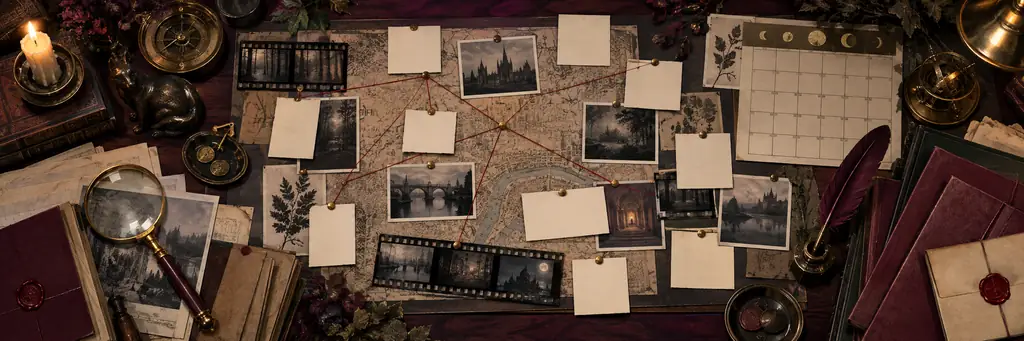
HBO’s Finding Harry: The Craft Behind the Magic documents the making of the first season through the people responsible for casting, production design, costume design and creature effects. The programme is narrated by Nick Frost and includes appearances by John Lithgow, Janet McTeer and Paapa Essiedu. This guide uses HBO’s programme description and the official Harry Potter editorial summary; it does not treat promotional enthusiasm as an independent review.
WBD programme entry ↗ · Official craft summary ↗ · Checked 14 September 2026.
Specific details that can be attributed to the published making-of material.
The production describes nature as a recurring influence. Vines, trees and botanical patterns appear in sets, packaging, banners, wands and clothing rather than being confined to one location.
Hogwarts uniforms use natural materials including British wool and organic cotton. The Muggle world is contrasted through synthetic fabrics and recognisably 1990s colours and clothing.
The creature team built animatronic animals, including an owl said to contain 36,000 feathers and a practical Scabbers model. Dugbog and Flobberworm designs are also shown.
The published material reveals the Great Hall, Potions classroom, Diagon Alley and Platform Nine and Three-Quarters as deliberately differentiated environments.
Details highlighted in the official summary include Ron’s Chudley Cannons badge and references to his first-book encounter with Malfoy. These support a close-reading approach but do not establish episode order.
The official account says more than 40,000 candidates were considered for Harry. The number describes the search process, not the eventual performance or audience response.
When the series arrives, compare how the natural design language is applied across departments. Does it connect costume, architecture and props, or does each department use it differently? Notice the boundary between practical construction and digital extension, and compare the deliberately ordinary Dursley environment with the handmade irregularity of magical spaces.
Official: Finding Harry: The Craft Behind the Magic is HBO’s behind-the-scenes special about the first season. HarryPotter.com’s announcement names Nick Frost as narrator and identifies cast participants including John Lithgow, Janet McTeer and Paapa Essiedu. It offers a useful starting point because makers can speak about their own work. The official trailer and the published feature linked below are accessible routes into that material.
When watching any making-of programme, distinguish a participant explaining a decision from a montage illustrating the subject. An interview can establish why a maker chose a particular approach when the explanation is explicit. A workroom shot may simply establish that an object was being developed. The finished episode provides another stage of comparison: something shown during production can change before the audience sees it in context.
Industry context — ScreenSkills: production designers work with directors, directors of photography and other department heads to develop a screenplay visually. That work concerns an overall world, not merely the appearance of one attractive room. Set decoration and the selection of objects contribute to how a place feels used. The official Harry Potter briefing identifies Mara LePere-Schloop as production designer and Naomi Moore as set decorator.
A useful way to appreciate this craft is to notice what a space suggests about its occupants. Objects can imply routine, status, age or taste before a character explains them. For the finished programme, look at the difference between the objects a character handles and the environment surrounding them. Both may support the impression of daily life, but the image alone does not establish which individual chose every item.
Industry context — ScreenSkills: costume designers develop clothing in relation to the script, characters and the production’s visual approach, working through designs with the director and producer. The official series briefing names Holly Waddington as costume designer. Clothing and accessories are therefore a professional design contribution with their own research and making processes, rather than simply items performers happen to wear.
For a viewer, silhouette, fit and the way a costume moves can be as expressive as colour. Ask how an outfit affects a character’s apparent ease or discomfort in a setting. A repeated garment may also become part of recognition. Those are observations to make from the finished programme; an explanation of a particular fabric, period reference or construction method should come from the costume team or another primary production source.
Industry context — ScreenSkills and the National Careers Service: direction and cinematography turn the script and physical environment into moving images. The director shapes the telling of the scene; the director of photography contributes expertise in the camera and lighting approach. The official briefing names Adriano Goldman as director of photography. These roles collaborate with other departments rather than operating after design has been completed in isolation.
The viewing question is how much of a space the image allows you to understand. A wide view can make geography clear, while a restricted view can withhold it. Where people stand and when the camera moves can change the balance between confidence and vulnerability. This gives fans a concrete way to discuss a scene’s atmosphere without guessing at equipment, lenses or unpublished technical specifications.
Official: John Nolan is identified as creature effects design supervisor, Mark Holt as SFX supervisor, Alexis Wajsbrot as VFX supervisor and Dom Sidoli as VFX producer. These are distinct credits. ScreenSkills’ VFX guide describes a field involving artistic and technical disciplines, while its supervisor profile explains leadership in realising the director’s and producers’ visual aims. The category name alone cannot tell us exactly how a particular Harry Potter shot was assembled.
When a published demonstration shows a mechanism, it can establish how that demonstrated object works. It does not necessarily explain every shot involving the finished creature or effect. The best reading of making-of material follows the particular example being explained. This avoids turning one interesting practical device into a blanket statement that an entire sequence used a single technique.
Industry context — ScreenSkills: post-production includes editing footage, adding visual effects and mixing music and sound. These processes help shape pace, clarity and atmosphere. A finished magical moment may depend as much on the duration of a reaction or a sound arriving at the right time as on the image being discussed. The production-departments guide gives a broader route through those roles.
For a careful rewatch, follow one transition. Notice what the sound tells you before the next image appears and how long the scene remains with a character after the main action. You can describe the effect on your viewing without claiming to know the private discussion that produced it. A maker’s explanation can then deepen that observation where an official interview supplies one.
The official source links let you watch the publicity and making-of material in the form its publisher provides. Our guide uses original writing and labelled illustration rather than reproducing studio photography. That keeps the distinction between a fan’s explanation and the production’s own visual material clear.
Choose one interest for your next visit: costume, sets, creatures or the camera. Follow the credited person’s professional profile, then return to a specific scene when episodes are available. A small, concrete question — how a doorway frames an entrance, or why a garment restricts movement — is often a more rewarding starting point than trying to explain the entire world at once.
Craft Announcement · Craft Studios · Screenskills Design · Screenskills Costume · Screenskills Director · Screenskills Map · Screenskills Vfx · Screenskills Post · Ncs Dop · Official Series